Compensation enters the era of AI

Crystal Romero
Director of Content
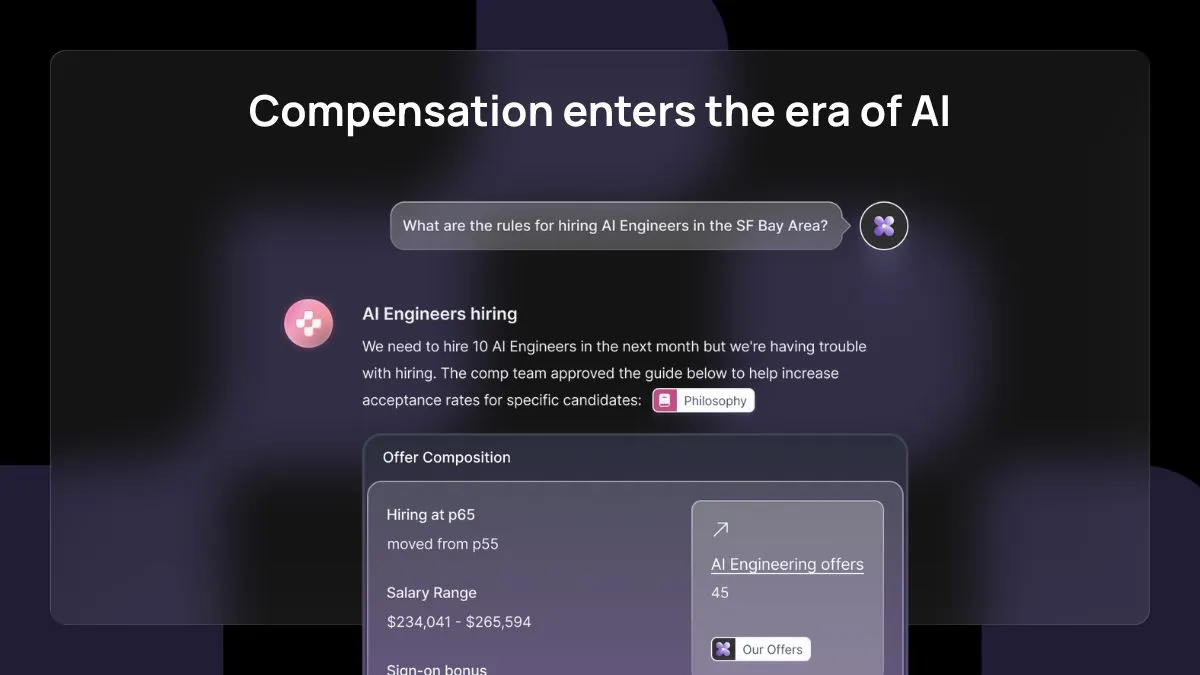
Introducing Compa Agents, and my vision for the future of compensation
Today I am proud to announce Compa Agents, building on our sneak preview at Compalluminati 2025, and marking the beginning of the AI era for compensation.
Compa is launching two agents:
- Analyst AI — automated compensation market intelligence
- Partner AI — comp-controlled agent for recruiters to make offers
In this post I will share my vision for the future of compensation, our AI strategy at Compa, and how Compa’s first agents work.
Over the next few months, I will write more posts diving deeper into the impact of AI on compensation, including the economic potential, impact on compensation teams, and the potential pitfalls our industry will confront with this disruptive new technology.
How AI changes compensation
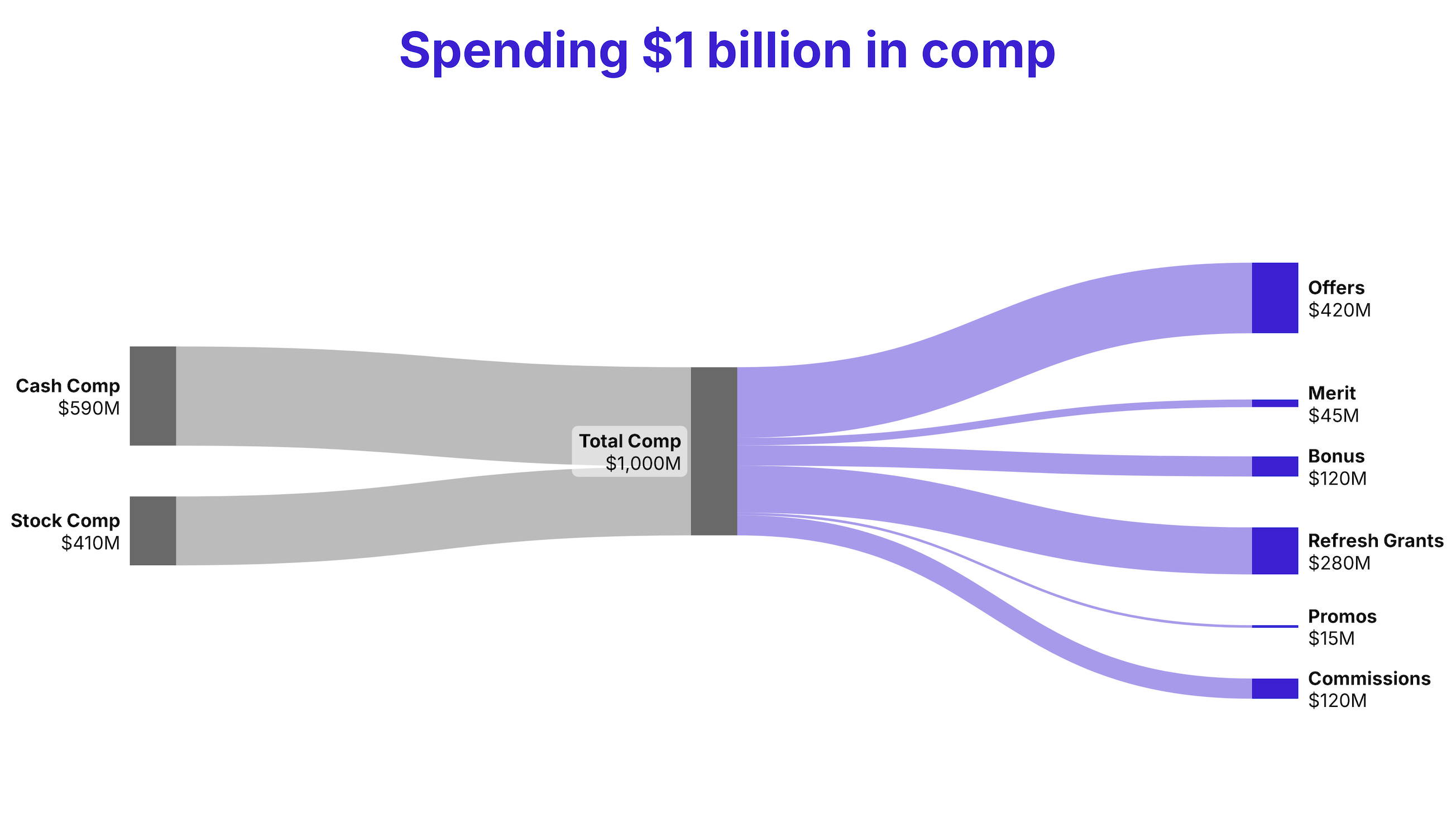
Every compensation team faces an impossible task — how do we manage our company’s largest investment, balancing cost, competitiveness, and fairness?
Our goal is to design an integrated set of compensation principles, policies, workflows, and data — in aggregate, our compensation strategy — to cost-effectively compete in talent markets.
Two big problems
Designing comp strategy is hard, but implementing it at scale is harder, for two major reasons:
- Compensation expense is fragmented, not monolithic — billions in investments each year are made across thousands of decisions
- Market conditions change constantly and non-uniformly — in the same short timeframe we may observe spiking engineering salaries in India, layoffs in G&A management, and emerging skill premiums in quantum computing
Our compensation strategy, implemented to scale, is executed by hundreds or thousands managers and recruiters who often don’t understand why or how it works.
And conditions on the ground across dozens of talent markets change faster than we can detect them and respond.
As a result, we risk overspending (and underspending) our companies’ biggest investment each year.
And so of course, every small-but-mighty compensation team is on the hunt for greater precision and controlled outcomes.
Agents 10x comp productivity
AI technology, specifically agentic AI, is poised to transform compensation because it scales intelligence to thousands of decisions in dynamic market conditions.
Agents can perceive data and learn, reason based on rules and goals, make decisions, and even act autonomously.
A 10-person compensation team cannot advise on 40,000 pay decisions each year. Instead, the team triages, focusing human review on maybe 10% (4,000) of those decisions: a small number of exceptions and big-ticket packages and relying on broad policies, discretion, and reactive data to manage the rest.
With AI, however, that same 10-person team can develop agents to guide every decision, applying not just its compensation strategy, but also real-time market data, changing business objectives, and feedback learning from the agentic interaction itself.
Agentic AI changes compensation because it unlocks precision and control at scale.
And its adoption is inevitable because the numbers are so big:
A compensation team managing $1 billion in investment each year that optimizes spend by 5% produces $50 million in value.
Compa’s AI strategy
Compa is a compensation intelligence company.
What does this mean?
We can define intelligence generally, and understand our innovation roadmap, by studying the anatomy of a decision.
The OODA Loop
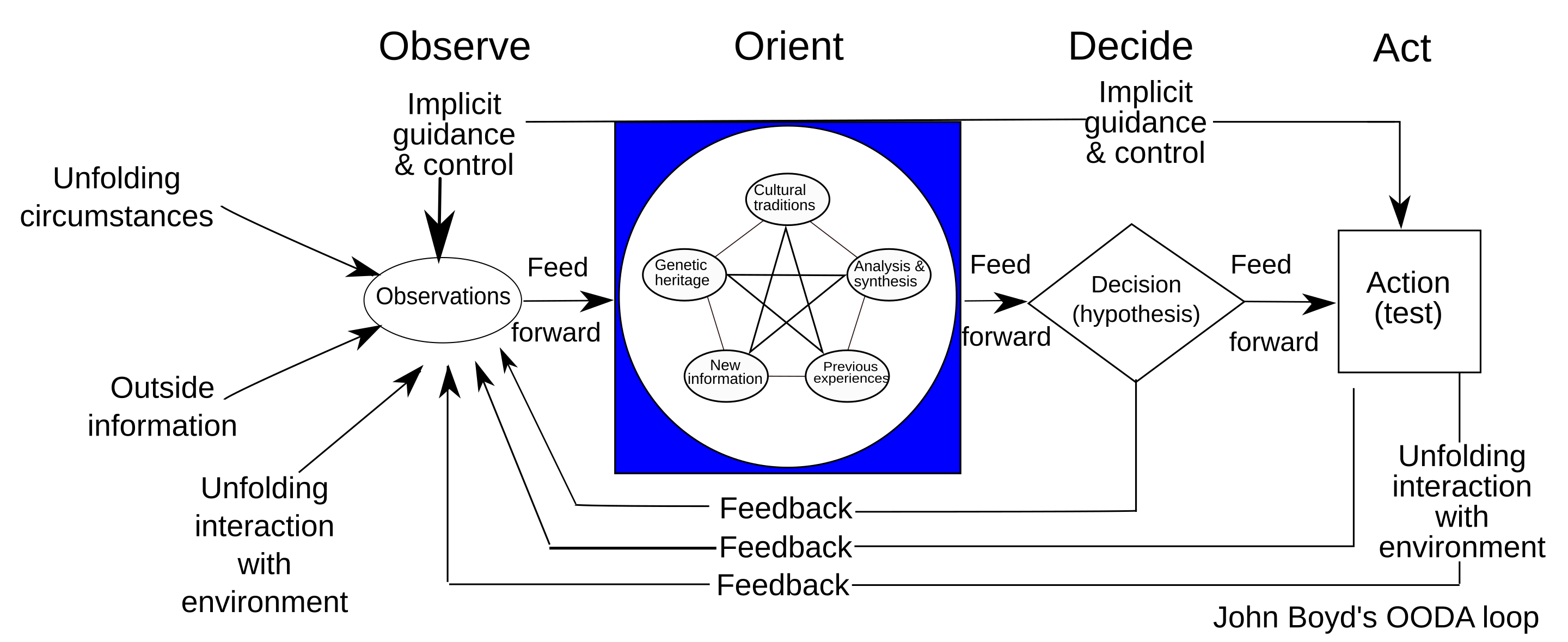
Last year I read Boyd: The Fighter Pilot Who Changed the Art of War, the autobiography of John Boyd, a US Air Force pilot who developed the OODA Loop decision-making model, an acronym that stands for Observe, Orient, Decide, Act.
This concept has been successfully applied in military operations, most famously in Operation Desert Storm, and subsequently in corporate strategy, litigation, and myriad other areas.
The OODA Loop consists of four stages
- Observe: detect new information
- Orient: contextualize the new information
- Decide: choose a course of action
- Act: execute the decision, then re-enter the loop
Here’s a simple example in business, courtesy of asking ChatGPT:
A company sees a drop in customer satisfaction (observe), realizes it’s due to support delays (orient), decides to deploy a support chatbot (decide), implements the bot (act), and then re-evaluates based on new data (back to observe).
Our Roadmap

As a compensation intelligence company, Compa’s innovation roadmap is a progression through the anatomy of a decision.
- ✅ Observe: Real-time market data
Compa started with real-time market data to provide visibility to new information. Instead of waiting 12 months to know what’s happening in the market, you can discover it now - ✅ Orient: Comp analysis tools
Compa’s analysis tools help contextualize real-time market information, including peer groups, geo tiers, unvested equity risk, trend analysis, and more - 📣 Decide: Compa Agents (new)
Compa Agents mark entry into the back-half of the OODA Loop, bringing automation and scaled decision-making to comp teams and their stakeholders - 🤫 Act: Coming Soon
Compa Agents can automate a limited set of high-impact workflows, with more coming soon
Compa is now the largest real-time market data network in the world, and growing faster than ever.
With Compa Agents, compensation teams can apply this intelligence to comp decisions at scale to achieve massive ROI.
How Compa Agents work
Compa is launching two agents, Analyst AI and Partner AI.
These agents are designed to solve the two big problems with implementing compensation strategy at scale:
- Analyst AI — market conditions change constantly and non-uniformly
- Partner AI — compensation expense is fragmented, not monolithic
Here’s how they each work.
Analyst AI is for comp teams
Analyst AI is automated compensation intelligence for comp teams.
This agent accelerates the work of a comp analyst. Market research is fully automated by a configurable agent that monitors the market 24/7.
Analyst AI compresses days of manual digging and research into instant real-time analysis:
- Analyze retention risk for a key engineering team
- Recommend ranges for entering a new market
- Understand market shifts for hot jobs and skills
- Evaluate geo tiers based on recent market trends
This is a big shift to move from doing the analysis to directing the analysis and processing available decisions instantaneously.
Partner AI is for recruiters, controlled by comp
Partner AI is a comp-controlled agent for recruiters to make offers.
This agent is natively integrated with Compa’s real-time offers-based market data network, and comp teams can add any data, structured or unstructured, to provide more context and configure rules and access for guiding recruiters to better decisions.
Partner AI embeds comp expertise into each one of your thousands of offer decisions, enabling you to automatically guide hundreds of recruiters toward controlled outcomes with measurable ROI. Examples:
- Limit sign-on bonus usage to targeted scenarios
- Guide higher offers for hot skills
- Navigate offer negotiations accurately
- Review exception requests automatically
- Remind recruiters of key talking points on your comp programs
Fascinatingly, recruiter interaction with the Partner AI agent becomes its own source of feedback data at scale, enabling you to analyze competing offers, detect emerging market trends, and pinpoint pressure on your ranges.
Get involved
A special group of customers have entered our Design Partner Program and are currently onboarding Compa Agents and working directly with my product team to provide feedback and influence our roadmap.
If you are interested in getting involved, shoot me a note and let’s discuss availability in the next cohort of companies onboarding into Agents later this summer.

In the meantime, we sat down with our Design Partners to talk about how top comp leaders are thinking about AI Agents, including the value proposition, risks, and how configurability should work — you can read the report here.
One more thing
The AI era represents a bright future for compensation.
Fundamentally, we are small, highly-leveraged teams managing billions in investment. Better data and AI technology increase our productivity and impact on the company’s growth strategy, perhaps more than any other team in HR.
My co-founders and I have designed Compa as a compensation intelligence company aimed squarely at powering smarter compensation decisions.
We are committed to bringing responsible, high-impact agentic AI into the domain of enterprise compensation.
…And with that commitment, we made a small change on our website:
.webp)
