Guide
How to Brief the Business on AI/ML Hiring
4 min read · March 19, 2025



AI hiring is outpacing traditional compensation models, forcing companies into tough decisions.
Leadership wants top AI talent fast, but pay is increasing beyond standard software engineering salaries—creating friction between hiring urgency, budget constraints, and market realities.
Whether your organization is building an AI business unit, expanding AI hiring, or refining compensation strategies, this guide provides a structured approach to briefing executives with clear, actionable insights.


“We believe the introduction of gen AI signifies a transformative era set to drive growth for us and our clients over the next decade.”
Why AI hiring breaks traditional pay models

AI candidates demand salaries far beyond standard software engineering ranges.

Senior hires want 7x more than existing pay structures allow.

The Compensation Committee expects a premium, but it's beyond expectations.

When hiring stalls, the CEO turns to the compensation team for answers.
Your job? Brief leadership on the AI talent market and deliver clear recommendations to get hiring back on track.
Here’s a 3-step approach comp leaders can take to get it right:
Step 1:
Define the market and set context
What AI roles is the business hiring for?
AI Researchers and AI Engineers come from separate job markets with different salary ranges. Most companies need far more Engineers than Researchers—which might surprise your CTO.
Aligning with hiring managers will reveal key details like whether most roles require PyTorch expertise or research experience—creating the foundation for compensation.
Where are we hiring?
Are we targeting the right markets? Are those markets as cost-efficient as possible? Who are our competitors?
Answering these questions allows comp teams to refine benchmarking and adjust pay strategies.
Do AI roles require different pay structures?
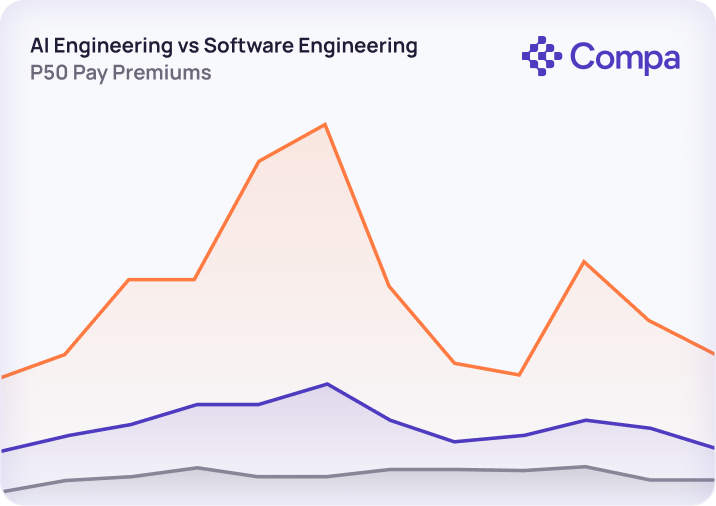
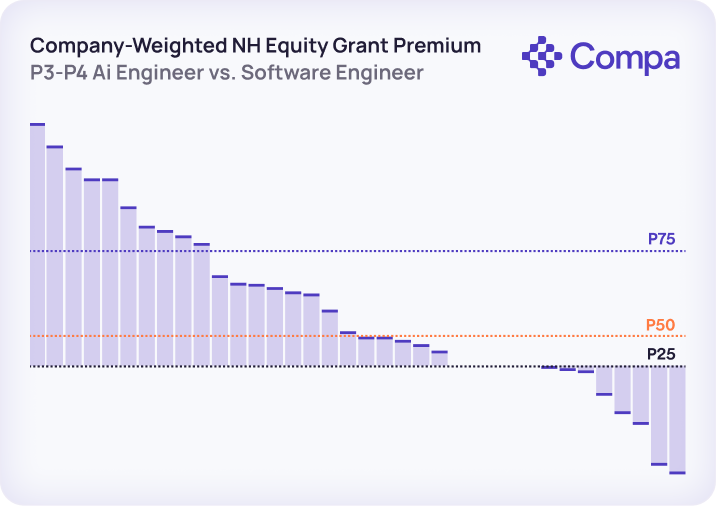
Base salaries for AI Engineers vs. Software Engineers show limited differences, but equity premiums for AI engineers range from +95% to -39%, creating a critical pay distinction.
With this foundation, comp teams deliver insights that help leadership navigate AI hiring with specificity and confidence.
Step 2:
Analyze the market and hiring performance
Pay structures differ
AI’s top talent—the unicorns—play by different compensation rules. Top AI engineers (95th percentile) have different pay structures than software engineers.
- Unvested equity for AI unicorns is 4-5x higher than software engineers.
- Competitors are using off-cycle equity grants to retain AI unicorns; don’t be shocked when candidates have millions in "golden handcuffs".
- Unicorn sign-ons cover 15% of unvested value, so despite what the CTO or TA says, overspending on cash sign-ons isn’t necessary.
Cost breakdown: AI vs. SWE hiring
If you assume AI hiring costs mirror SWE benchmarks, the numbers tell a different story:
- 200 AI hires = $135M
- 200 SWE hires = $78M
- AI hiring costs 72% more—a $56M difference
If Finance plans headcount using SWE costs, total spend is understated by $56M. To stay within budget, a company can’t afford 200 AI engineers—it can only hire 116.
For comp teams, aligning with Finance early ensures AI hiring strategies are competitive and financially sound.

"High unvested equity for top AI talent isn’t a challenge—it’s a signal. Smart comp teams will rebalance with smaller sign-ons and structured new hire grants to stay in the game without overpaying."
Step 3:
Deliver clear, actionable recommendations
To make AI hiring both competitive and financially sustainable, comp teams need to align with leadership on strategy.
Here’s 4 key ways to drive the right conversation in every meeting with business partners:
01 — Create AI-specific pay ranges
- For clarity, separate equity premiums from base salary.
- Use tailored pay structures for AI roles to stay competitive without overpaying.
02 — Use offers-based market insights
- Surveys will set you up for failure—real-time offer data is essential for tracking AI hiring trends.
- Include sign-on bonus trends and unvested equity dynamics.
03 — Get smart on workforce planning
- Adjust cost models to reflect true AI hiring expenses—not software engineering benchmarks.
- Reevaluate headcount projections to balance budget constraints with hiring goals.
03 — Monitor retention risk
- AI talent moves fast. Without proactive retention strategies, companies risk losing key hires as quickly as they secure them.
- Track compensation for current employees to assess retention risks.