The Attraction Playbook for Critical Talent

Ashley Case
Director of Insights

Bree Linck
Compensation Program Manager
The AI talent market is ultra-competitive. Here's how to build an offer strategy that actually wins.
The supply of qualified AI talent has never kept pace with demand. Companies are competing for a pool of engineers and researchers that simply isn't growing fast enough - and every organization that gets serious about AI is bidding in the same auction. If your offer strategy isn't deliberate, you're not losing due to luck. You're losing to organizations that did the work.
Winning the offer isn't just about the number. The candidates who matter most are evaluating your comp structure, your mission, your leadership, and whether working for you is worth turning down everyone else. This piece covers how to compete on the financial side. We'll cover the human side in Part 3.
A note on scope: AI and ML talent is today's hardest segment to attract, but the same dynamics apply to any hard-to-fill role where demand outpaces supply. If you're competing for a small pool of specialized candidates who have multiple offers on the table, this playbook is for you - regardless of the job title.
Start With Your Foundation
Sign-on bonuses get headlines, but they can't rescue a compensation structure that isn't competitive at its core. Before writing bigger checks, make sure the foundation will hold.
Revisit your job architecture. AI and ML roles have evolved faster than most job frameworks can track. Roles building AI products carry different market premiums than roles that incorporate AI into existing functions - don't price them the same way.
Revisit your compensation philosophy. Should AI/ML talent sit in a different market segment or peer group? Should you target a higher percentile for these roles (for example, some companies target the 75th or even 90th percentile)? These need deliberate answers, not defaults carried over from last year's survey data.
Reexamine your pay mix. In Compa’s Offers Data, we are seeing pay mix trending towards more cash compensation and while average new hire grants declined.
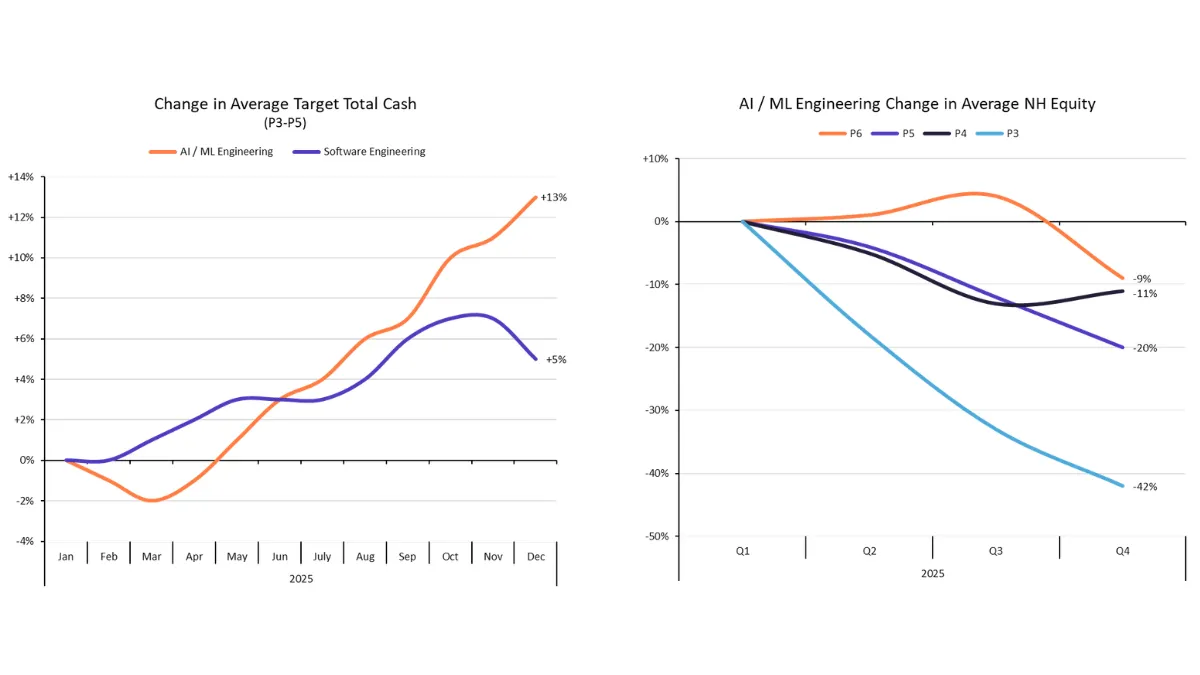
Source: Represents offers in Compa’s data network for Tier 1 cities (SF Bay, NYC, Seattle)
Benchmark constantly. Check your market data at least monthly for AI/ML roles. Candidates know what the market is paying - and they'll know if you don't. As shown above, in 2025, P3-P5, average target total cash increased more than twice as fast as cash comp for comparable software engineering roles.
Know which roles truly need a premium. Not every AI-adjacent position commands the same market rate. A deep learning engineer and a project manager on an AI project are very different problems. Compa’s Skills Product can help you be specific about where you're competing at the top of market, and why.
Sign-On Awards: The Right Tool for the Right Moment
Sign-on awards can close the deal on hard-to-fill roles, signal genuine commitment to the AI space, and bridge gaps for candidates weighing multiple offers or walking away from unvested equity. But they're a short-term tool - and treating them as a long-term strategy is a trap.
Ask yourself:
- Are sign-ons patching a structural comp problem? If so, the real fix is your philosophy and ranges - not a bigger check at hire.
- Do we have a clear eligibility strategy - which roles, which levels, which teams - to avoid spend creeping into areas that don't need it?
- Do we have parameters? For example, many companies cap sign-on bonuses as a percentage of salary based on job family and level.
- What vesting or repayment terms will drive longevity, not just acceptance?
Watch the cliff. Front-weighted vesting attracts candidates, but it also attracts people who chase upfront compensation and leave once the majority vests. Design terms with eyes open.
Sign-on bonus trends. For AI/ML roles, Compa is seeing sign-on bonuses given at a much higher rate than traditional software engineering roles and corporate functions.
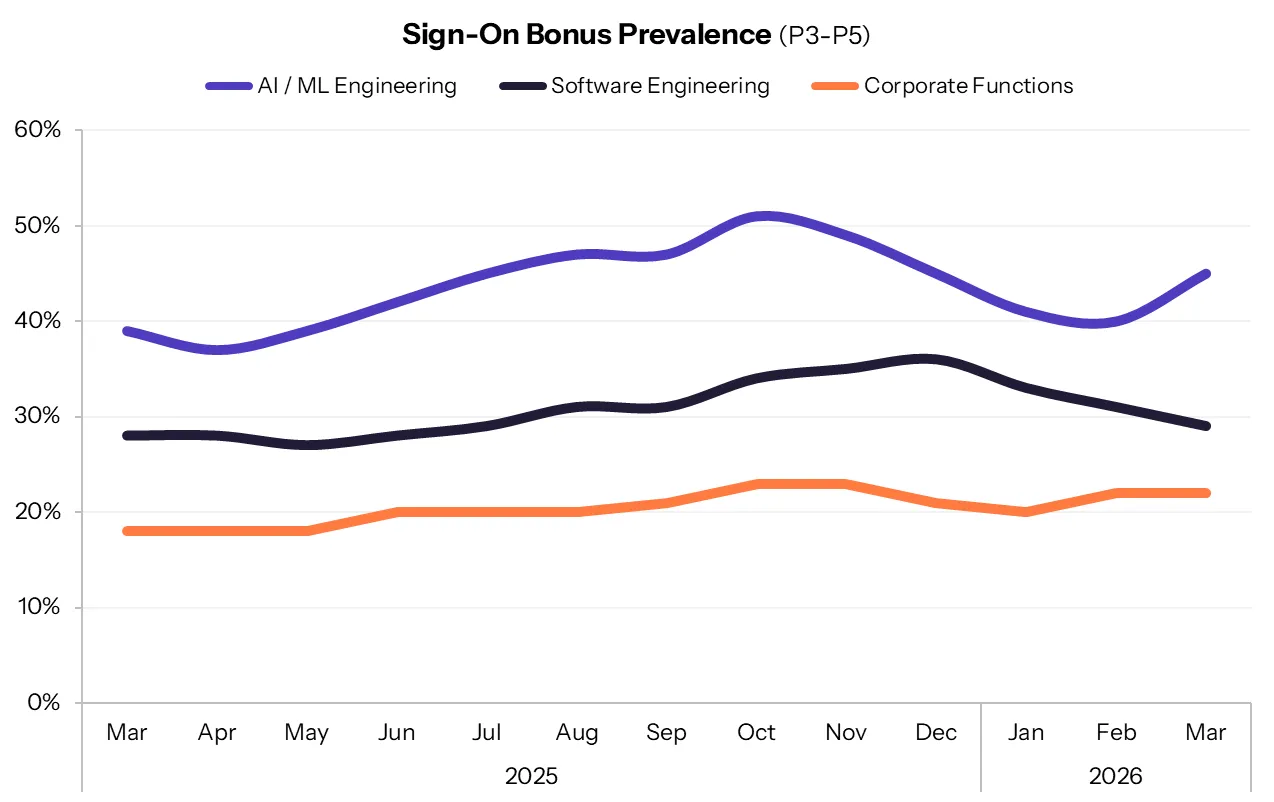
Source: Represents offers in Compa’s US data network
On delivery: Sign-on awards can be structured as cash or equity depending on candidate preference and your share pool constraints. Coordinate with finance and stock partners before budgeting - especially if mega offers are on the table for elite roles.
Beyond the Offer Letter
The candidates who matter most aren't just evaluating your comp package. They're evaluating whether your organization is worth their career.
Some candidates will prioritize startup speed and low bureaucracy. Others want the stability and resources of a scaled enterprise. A meaningful and growing segment of AI talent specifically prioritizes building responsibly and safely. Your recruiting conversations need to speak to what this candidate values - which means your talent acquisition team needs to know how to ask, and how to answer.
Do this now:
- Equip your TA team to articulate your EVP clearly - mission, culture, resources, and leadership - not just comp.
- Involve senior AI leaders in interviews for top candidates. Elite talent wants to know who they'll be learning from.
- Make sure your resource commitments - compute, tooling, research time - match what you're promising in the room. A gap here gets discovered fast, and it costs you more than the offer did.
- The bar here is already moving: Nvidia's Jensen Huang said in his Keynote at NVIDIA’s GTC Conference on Monday, March 16th that token access is already a recruiting conversation in Silicon Valley — "how many tokens come along with my job." If your AI candidates aren't asking that question yet, they will be.
We'll go deeper on the human side of attraction in Part 3.
The Bottom Line
The candidates you want most have options. Real ones. They're not just asking "what does this pay?" - they're asking "is this worth it?"
Build a foundation that's genuinely competitive. Deploy sign-on awards where the market demands them, not as a crutch for structural gaps. And start thinking now about what you'll say when the best candidate in the room asks why they should choose you over everyone else - because they will.
Up next - Part 3: The EVP Playbook for Critical Talent. The strategies winning critical talent that no offer letter can replicate.
Compa helps compensation teams benchmark AI/ML offers in real time. Download the February 2026 market brief The New Economics of AI Engineering Pay.

.webp)