The EVP Playbook for Critical Talent

Ashley Case
Director of Insights

Bree Linck
Compensation Program Manager
Getting comp right is non-negotiable. But in the tightest talent markets, it's the organizations that pair competitive pay with a compelling reason to be there that consistently win.
Compensation is your foundation. But even the most competitive package has a ceiling.
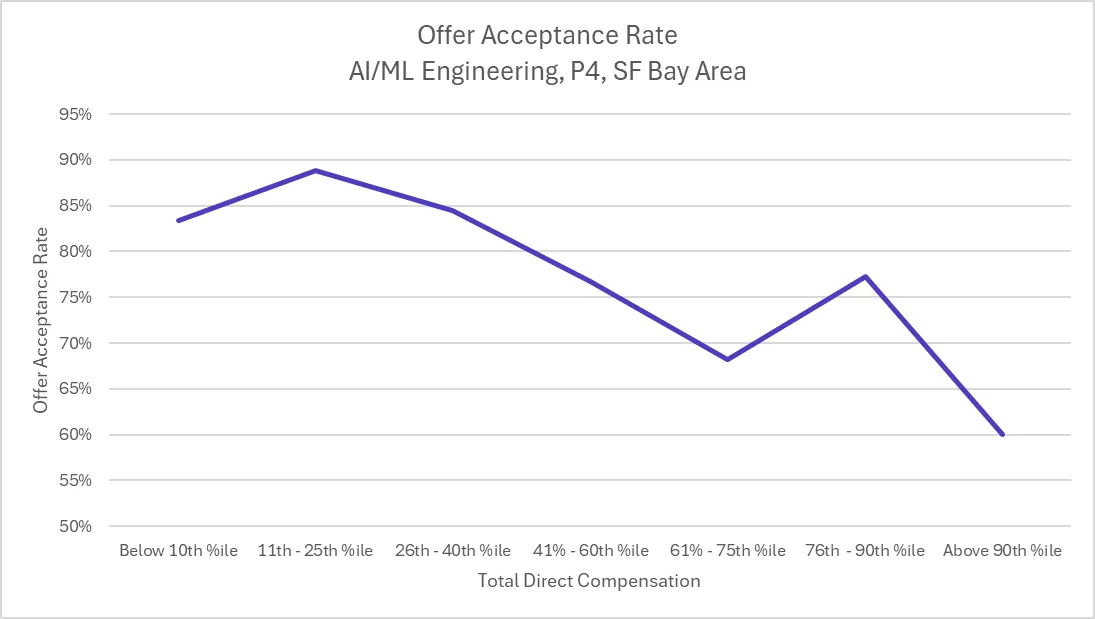
You can offer a competitive base, a generous bonus, a well-structured equity grant, and a thoughtful sign-on - and still lose the candidate. Or make the hire, only to watch the person disengage six months in. The organizations winning the AI talent war right now aren't just getting comp right. They're pairing it with something the competition can't easily replicate: a compelling reason to be there. As shown below, Compa’s data suggest that offers at higher percentiles are actually less likely to be accepted - there has to be a non-compensatory reason to change roles.
Anthropic CEO Dario Amodei put it plainly: "What they are doing is trying to buy something that cannot be bought. And that is alignment with the mission."
This is the final piece in our trilogy, The Critical Talent Playbook. Parts 1 and 2 covered the financial playbook - retention awards, attraction strategies, comp foundations. This piece covers what amplifies all of it: the employee value proposition that makes a competitive package actually land.
A note on scope: AI and ML talent is the most visible flashpoint right now, but a strong EVP isn't an AI strategy - it's a people strategy. Everything in this piece applies to all employees and the critical talent your organization depends on, regardless of function or title.
Why the EVP Has Never Mattered More
In AI, the best candidates don't apply. They get recruited - repeatedly, aggressively, and by organizations with very deep pockets and compelling pitches. Competitive compensation gets you to the table. The EVP is what closes the deal - and what keeps people from leaving when the next offer arrives.
The mistake most organizations make is treating the EVP as a marketing exercise - a polished careers page and a well-rehearsed pitch. But the candidates and employees who matter most are good at spotting the gap between what a company says and what it actually does. That gap is one of the fastest ways to lose people. In a market where everyone is competing on pay, the organizations that also mean what they say on culture and mission stand out.
Culture, Mission, and Values
AI talent is not a monolith. Some want startup speed and low bureaucracy. Others want the stability and resources of a scaled enterprise. A meaningful and growing segment prioritizes building AI safely and responsibly - and they'll trade comp for an organization whose values genuinely align with their own.
The question isn't whether your organization has a mission. It's whether your people believe it, whether your leaders model it, and whether your practices actually reflect it.
For candidates:
- Equip your TA team to articulate the EVP authentically - not just recite it. Candidates ask hard questions. Your recruiters need real answers.
- Involve senior AI leaders in interviews for top talent. Elite candidates want to understand who they'll be learning from and what the organization is actually building.
- Be honest about where you are on responsible AI development, not just where you aspire to be. Credibility matters more than polish.
For existing employees:
- Use stay interviews to understand what your people actually value - and what would cause them to leave. The questions that tend to surface the most actionable intel:
- What do you look forward to when you come to work? - reveals what's working and worth protecting
- What would make you update your resume? - gets at real flight risk more directly than "what might change that"
- Where do you want to be in two to three years, and do you see a path to get there here? - exposes career pathing gaps that are a top driver of attrition
- What's one thing I could do better as your manager, and one thing we could do better as an organization? - invites honest feedback at both levels and surfaces issues a manager alone can't fix
- Hold leaders accountable to model the values, not just communicate them. Culture is set from the top down and felt from the bottom up.
- When your practices don't align with what employees say they value, address it. The disconnect is always discovered - usually at the worst possible moment.
Resourcing and the Chance to Do Something That Matters
Elite AI talent isn't just chasing pay. They're chasing impact. They want access to the compute, data, tooling, and research time to build something that actually matters - and they're evaluating your organization on whether it can deliver that. Investment in infrastructure isn't just a technical decision. It's a talent strategy.
For candidates:
- Be specific about your resource commitments in recruiting conversations. Vague promises about "investment in AI" are easy to see through. Concrete details about compute access, research time, and tooling are not.
- Make sure what you're promising in the room matches reality. A mismatch here gets discovered fast - and it costs you far more than the offer did.
For existing employees:
- Ensure your talent strategy matches your resource allocations. It doesn't make sense to hire top talent if they won't have what they need to be effective.
- Invest in learning and development. AI skills evolve at an extraordinary pace. People who feel like they're stagnating will find somewhere they won't.
- Elevate your internal AI thought leaders. Give them a platform - internally and externally. Encourage them to publish, present, and participate in recruiting conversations. Recognized leaders attract and retain talent in ways a comp package simply cannot.
The Bottom Line
Getting comp right is non-negotiable - it's the foundation everything else is built on. But in the tightest talent markets, competitive pay is a prerequisite. The organizations that consistently win and keep critical talent are the ones that pair a strong comp foundation with an EVP people actually believe.
Start by getting honest about the gap between what your organization says it stands for and what people actually experience. Close that gap, and your comp package becomes far more powerful. Leave it open, and no award structure in the world will hold your best people for long.
The talent war isn't won in the offer letter alone. It's won in the day-to-day - in the mission people feel connected to, the resources they have to do great work, and the leaders who make them feel like they're exactly where they should be.
This is Part 3 of The Critical Talent Playbook. Read Part 1: The Retention Playbook for Critical Talent and Part 2: The Attraction Playbook for Critical Talent.
Compa helps compensation teams benchmark AI/ML offers in real time. Download the February 2026 market brief The New Economics of AI Engineering Pay.

.webp)